

Cookies Policy

The website of the University of Cádiz uses its own and third-party cookies to carry out analysis of use and measurement of traffic, as well as to allow the correct functioning in social networks, and in this way to improve your browsing experience.

If you want to configure cookies, press the button Customize Cookies. You can also access the cookie settings at any time from the corresponding link in the footer.

For more information about cookies you can consult the Cookies policy from the website of the University of Cádiz.

Cookies customization

The website of the University of Cádiz uses its own and third-party cookies to carry out analysis of use and measurement of traffic, as well as to allow the correct functioning in social networks, and in this way to improve your browsing experience.

For more information about cookies you can consult the Cookies policy from the website of the University of Cádiz. You can also access the cookie settings at any time from the corresponding link in the footer.

You can configure the website cookies according to their purpose:

  • Statistical analysis

    Third-party cookies (Google Analytics) are used on this site that allow the number of users to be quantified anonymously (personal data will never be obtained to identify the user) and thus be able to analyze the use made by users of our service, in order to improve the browsing experience and offer our content optimally.

  • Social networks

    Third-party cookies are used on this website that allow the proper functioning of some social networks (mainly YouTube and Twitter) without using any personal data of the user.

UniversidaddeCádiz
Escuela Superior de Ingeniería
noticia

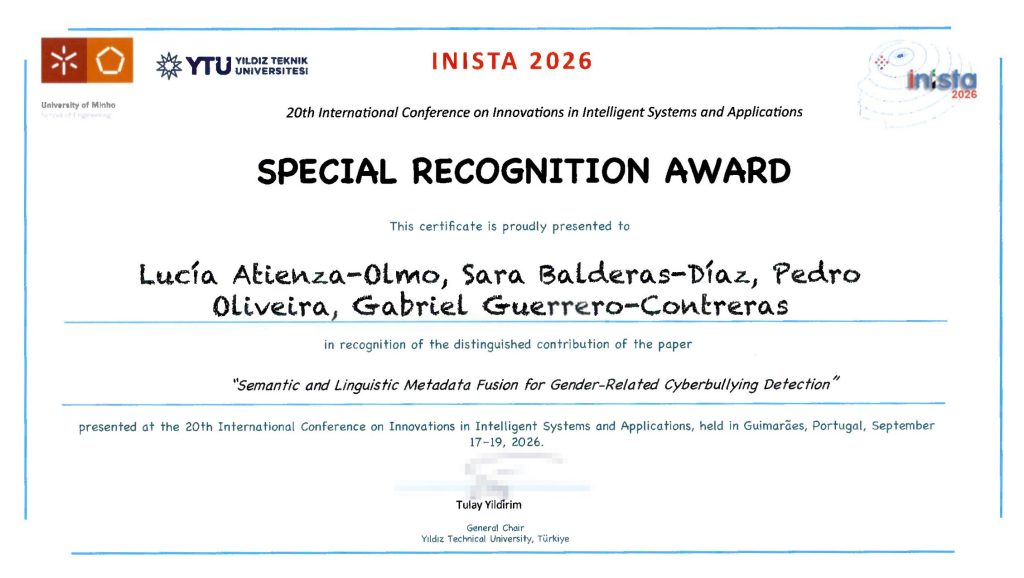
Una investigación sobre IA y ciberacoso de género recibe el Special Recognition Award en INISTA 2026 21 September 2026
Una investigación sobre IA y ciberacoso de género recibe el Special Recognition Award en INISTA 2026

Miembros del grupo UCASE de la Universidad de Cádiz, junto con investigadores del Centro ALGORITMI de la Universidade do Minho, han recibido un Special Recognition Award en la 20th International Conference on Innovations in Intelligent Systems and Applications (INISTA 2026), celebrada del 17 al 19 de septiembre en Guimarães (Portugal), por el trabajo Semantic and Linguistic Metadata Fusion for Gender-Related Cyberbullying Detection, desarrollado por Lucía Atienza-Olmo, Sara Balderas-Díaz, Pedro Oliveira y Gabriel Guerrero-Contreras. La investigación propone combinar modelos Transformer con información lingüística propia de las redes sociales, como el uso de mayúsculas, puntuación, hashtags, menciones, emojis o vocabulario ofensivo, para mejorar la detección automática de ciberacoso relacionado con el género en español e inglés.